
Malaysia stands as one of the world’s most passionate badminton nations, with decades of achievements and a fan base that fills stadiums for every major tournament. Badminton Malaysia represents not just a governing body but a cultural phenomenon that has shaped the country’s sporting identity since the mid-20th century. From producing Olympic silver medalists to hosting prestigious events like the Malaysia Open with prize money reaching US$1,450,000, the nation continues to dominate international courts. This immense sporting passion extends beyond the arena, driving a vibrant digital entertainment sector that includes platforms like DK88 casino. The 2026 season promises exciting developments, including the PETRONAS Malaysia Open at Axiata Arena in Kuala Lumpur.
Overview of Badminton in Malaysia
Badminton holds a unique position in Malaysian society, transcending mere sport to become a national passion. The Badminton Association of Malaysia (BAM) governs all competitive activities, youth programs, and international representation. Malaysia badminton players compete at the highest levels, consistently ranking among the world’s top 20 across multiple categories.
The sport’s infrastructure spans from grassroots academies in rural areas to elite training centers in Kuala Lumpur. Over 500 registered clubs operate nationwide, nurturing talent from age six through professional levels. Recent statistics show more than 2 million Malaysians play badminton recreationally, while approximately 8,000 compete in organized tournaments annually.
History and Development of Malaysian Badminton
The roots of badminton in Malaysia trace back to British colonial influence in the 1920s.

By 1934, the Badminton Association of Malaya formed, establishing formal competition structures. The sport gained momentum through the 1950s, with Malayan players beginning to compete internationally.
Malaysia’s breakthrough came in 1967 when the national team won the Thomas Cup, defeating Indonesia in the final. This victory sparked nationwide enthusiasm and government investment in training facilities. The 1970s saw the emergence of Punch Gunalan, who reached world number one in men’s singles.
The 1980s and 1990s marked the golden era of the Sidek brothers – Misbun, Jalani, Razif, Rahman, and Rashid. These siblings dominated doubles competitions and brought innovative techniques that influenced global playing styles. Jalani Sidek won the All England Championship in 1992, cementing Malaysia’s status among badminton elite nations.
Basic Rules and Match Formats
Modern badminton follows standardized BWF regulations. Matches consist of best-of-three games, with each game played to 21 points. A two-point margin determines the winner, though games extend to a maximum of 30 points.
Players must win by scoring 21 points first, with rally scoring applied. Service rules require the shuttle to be struck below waist height. Five disciplines exist: men’s singles, women’s singles, men’s doubles, women’s doubles, and mixed doubles. Each discipline has distinct tactical approaches, with singles emphasizing endurance while doubles focus on net play.
Major Badminton Tournaments in Malaysia
The Malaysian badminton calendar features numerous prestigious competitions. The Malaysia Open ranks as the country’s flagship event, classified as a Super 1000 tournament by BWF. Scheduled for January 6-11, 2026 at Axiata Arena, the tournament offers US$1,450,000 in total prize money.
Prize distribution follows BWF standards, with singles winners receiving $101,500 and doubles champions earning $107,300. The Malaysia Masters serves as another Super 500 event, typically held in late May or early June, providing crucial ranking points for players.
Regional competitions include the PETRONAS Malaysia International Series, scheduled for September 1-6, 2026 at Arena Badminton Perak in Ipoh. Entry fees stand at USD$40 per singles player and USD$70 per doubles pair, with USD$10,000 total prize money.
Malaysia Open and Other International Events
The Malaysia Open’s history stretches back to 1937, making it one of badminton’s oldest recurring tournaments. The modern format stabilized in the 1980s. The event has been held primarily at Axiata Arena since 2015, which accommodates 15,000 spectators.
Tickets for the 2026 Malaysia Open went on sale November 3 via Ticket2u, with an early bird promotion running until November 30. Previous years show tickets sell out within hours of release, particularly for finals sessions.
Olympic badminton remains a pinnacle goal for malaysia badminton players. Lee Chong Wei’s three Olympic silver medals (2008, 2012, 2016) represent the nation’s best performances, though gold remains elusive. The quest continues with current generation athletes targeting future Olympics.
Famous Malaysian Badminton Players
Lee Chong Wei dominates discussions of Malaysian badminton greatness. His career spanning 2000-2018 produced 69 international titles, including three Olympic silvers and four Commonwealth Games golds. He held the world number one ranking for 349 weeks total. His rivalry with Lin Dan captivated global audiences and elevated the sport’s profile.
The Sidek brothers revolutionized doubles play during their 1980s-90s peak. Jalani and Razif Sidek won the All England Championship together, while Rashid excelled in mixed doubles. Their attacking style influenced coaching methodologies worldwide. Today, several Sidek family members work as national coaches.
Lee Zii Jia emerged as the current standard-bearer after Lee Chong Wei’s retirement. Born in 1998, he captured the All England title in 2021 and reached world number three ranking by 2022. His aggressive baseline attacks and deceptive net shots mirror Lee Chong Wei’s style.
Women’s badminton has seen gradual progress, with players like Goh Liu Ying making breakthroughs in doubles categories. Goh won Olympic silver in mixed doubles at Rio 2016, partnering Chan Peng Soon. Veteran players like Goh V Shem and Tan Wee Kiong achieved world number one ranking in men’s doubles during 2016.
National Team and International Competitions
The malaysia badminton team structure divides into senior and junior squads, with approximately 50 athletes holding national team status. Senior players train full-time at Bukit Kiara, receiving monthly allowances ranging from RM3,000 for development players to RM15,000 for Olympic medal contenders.
Thomas Cup campaigns define Malaysian men’s team ambitions. After the 1967 victory, Malaysia reached finals in 1988, 1992, 2014, and 2022. The team consistently places in semi-finals, demonstrating competitive depth but falling short against Chinese and Indonesian powerhouses.
Sudirman Cup mixed team events showcase balanced squad depth. Malaysia won bronze in 2013 and 2019, competing fiercely against top-five nations. Commonwealth Games provide medal opportunities, with Malaysian athletes winning 29 gold medals across all Games editions.
Badminton Clubs, Academies, and Youth Development
Over 500 registered clubs operate under BAM jurisdiction, ranging from school-based programs to private academies.
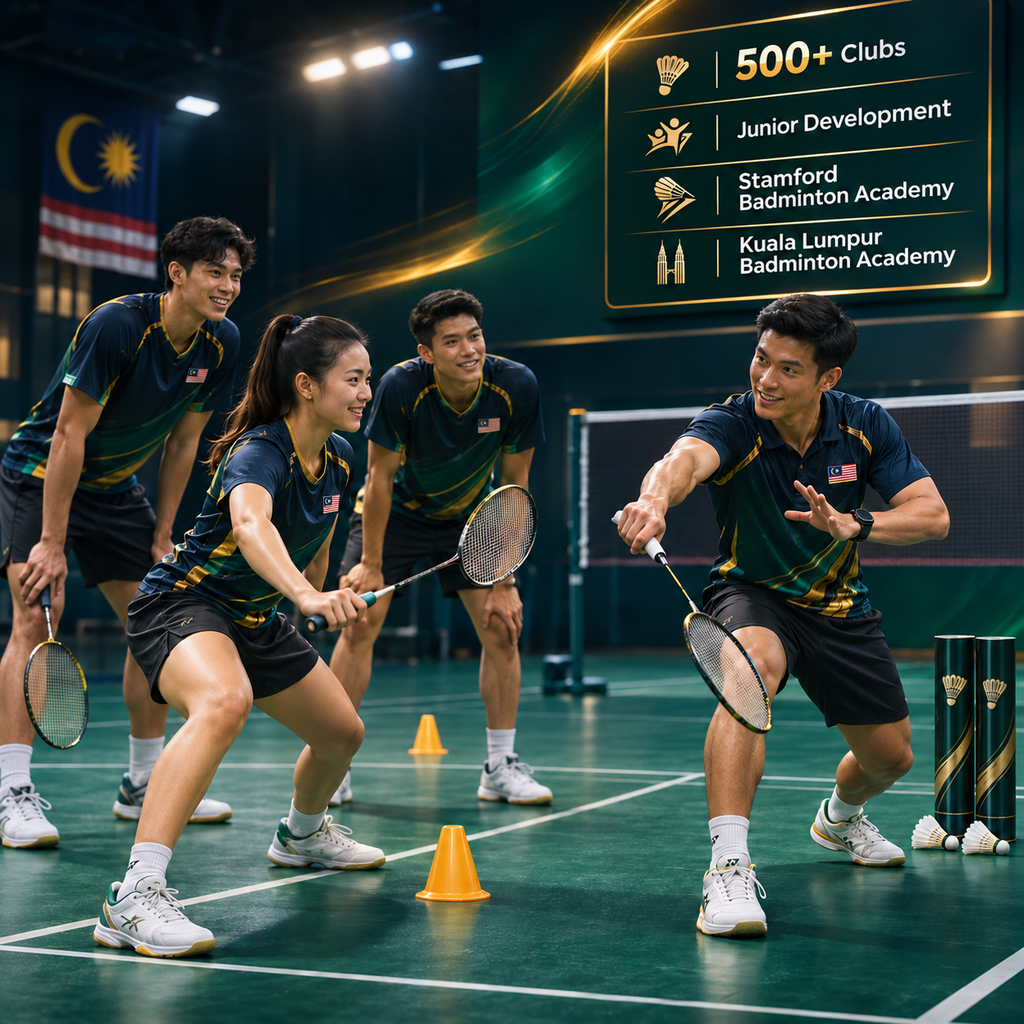
Membership fees vary from RM50 monthly for community clubs to RM500 for elite academies offering professional coaching.
The BAM Coaching Certification program requires all instructors to complete Level 1 basic certification. Approximately 1,200 certified coaches work nationwide, ensuring standardized technique instruction from grassroots through elite levels.
Youth development begins with the Junior Development Programme, identifying talent from age 8 through state-level competitions. Selected players enter residential academies at age 13, balancing education with 20 hours weekly training. The Bukit Jalil Sports School houses 200 athletes across multiple sports.
Private academies supplement national efforts, with notable examples including the Stamford Badminton Academy and Kuala Lumpur Badminton Academy.
These facilities provide individualized coaching, video analysis, and flexible scheduling for students.
Fan Culture and the Popularity of Badminton in Malaysia
Badminton’s popularity in Malaysia manifests through consistent sell-out crowds at major tournaments and extensive media coverage. The Malaysia Open sees high attendance across all days, with finals day reaching full capacity hours before first match. Television broadcasts attract 2-3 million viewers for crucial matches.
Fan clubs organized through social media coordinate stadium attendance, with members traveling from neighboring states for tournament days. The “Lee Chong Wei Army” exemplifies this dedication, with organized chanting sections creating intimidating home-court atmosphere. This support extends to current stars like Lee Zii Jia.
Grassroots participation remains extraordinarily high, with public courts constantly occupied during evening hours. Weekend tournaments at community levels attract hundreds of participants across age divisions. Corporate sponsorship reflects commercial value, with Petronas, Yonex, and Astro maintaining long-term partnerships with BAM.
The Future of Badminton in Malaysia
Strategic planning through 2028 focuses on reclaiming Thomas Cup victory and securing Olympic gold. BAM’s roadmap includes hiring foreign technical consultants, expanding sports science integration, and increasing international training camps. The annual budget allocation from the Ministry of Youth and Sports has grown to RM35 million.
Infrastructure upgrades target second-tier cities, with new complexes planned for Johor Bahru, Penang, and Kuching. These facilities will host regional tournaments, reducing burden on Kuala Lumpur venues and developing local fan bases.
Women’s category development receives prioritized attention after decades of underinvestment. The 2023-2026 cycle doubles female coaching staff and creates separate training schedules. Early results show improved junior rankings, with Malaysian girls reaching world top 20 in under-19 categories.
Technology integration includes AI-powered video analysis, opponent tracking databases, and biomechanics laboratories at Bukit Kiara. These tools provide competitive advantages in match preparation and injury prevention. Hosting major events remains strategic priority, with bids submitted for 2027 World Championships.
FAQ
What is Badminton Malaysia’s historical significance in international competition?
Malaysia won the Thomas Cup in 1967, defeating Indonesia and establishing the nation as a badminton powerhouse. Lee Chong Wei’s three Olympic silver medals and 69 international titles represent the pinnacle of individual achievement, while the Sidek brothers revolutionized doubles play during the 1980s-90s era.
When and where is the 2026 Malaysia Open scheduled?
The 2026 Malaysia Open takes place January 6-11 at Axiata Arena in Kuala Lumpur. Total prize money reaches US$1,450,000, with singles champions earning $101,500. Tickets went on sale November 3 via Ticket2u, with early bird discounts available until November 30.
Who are the current top malaysia badminton players to watch?
Lee Zii Jia leads men’s singles rankings, holding world number five status as of late 2023 and the 2021 All England Championship title. Aaron Chia and Soh Wooi Yik dominate men’s doubles, reaching world number two ranking. Pearly Tan and Thinaah Muralitharan show promise in women’s doubles.
How can young players join badminton development programs in Malaysia?
Young players enter development pathways through state-level competitions starting at age 8. The Junior Development Programme identifies talent for residential academy placement at age 13. BAM-affiliated clubs operate in all states, offering coaching from RM50 monthly.
What makes badminton so popular in Malaysian culture?
Badminton’s accessibility drives widespread participation, with courts available in most housing estates. The sport requires minimal equipment costs, while year-round tropical climate permits outdoor play. National heroes like Lee Chong Wei inspire grassroots interest, and consistent government investment ensures quality facilities.
What tournaments beyond the Malaysia Open does the country host?
Malaysia hosts the Malaysia Masters Super 500 event annually, plus the PETRONAS Malaysia International Series scheduled for September 1-6, 2026 in Ipoh with USD$10,000 prize money. Regional tournaments including the Pahang Open, Selangor Open, and Penang International provide competitive opportunities at national and international levels.
How does the malaysia badminton team prepare for international competitions?
The national squad trains full-time at Bukit Kiara Sports Complex with 20 courts and comprehensive sports science facilities. Training schedules include 6 hours daily on-court work, supplemented by strength conditioning, video analysis, and match simulation. Players attend 8-10 international tournaments annually for competitive exposure.